
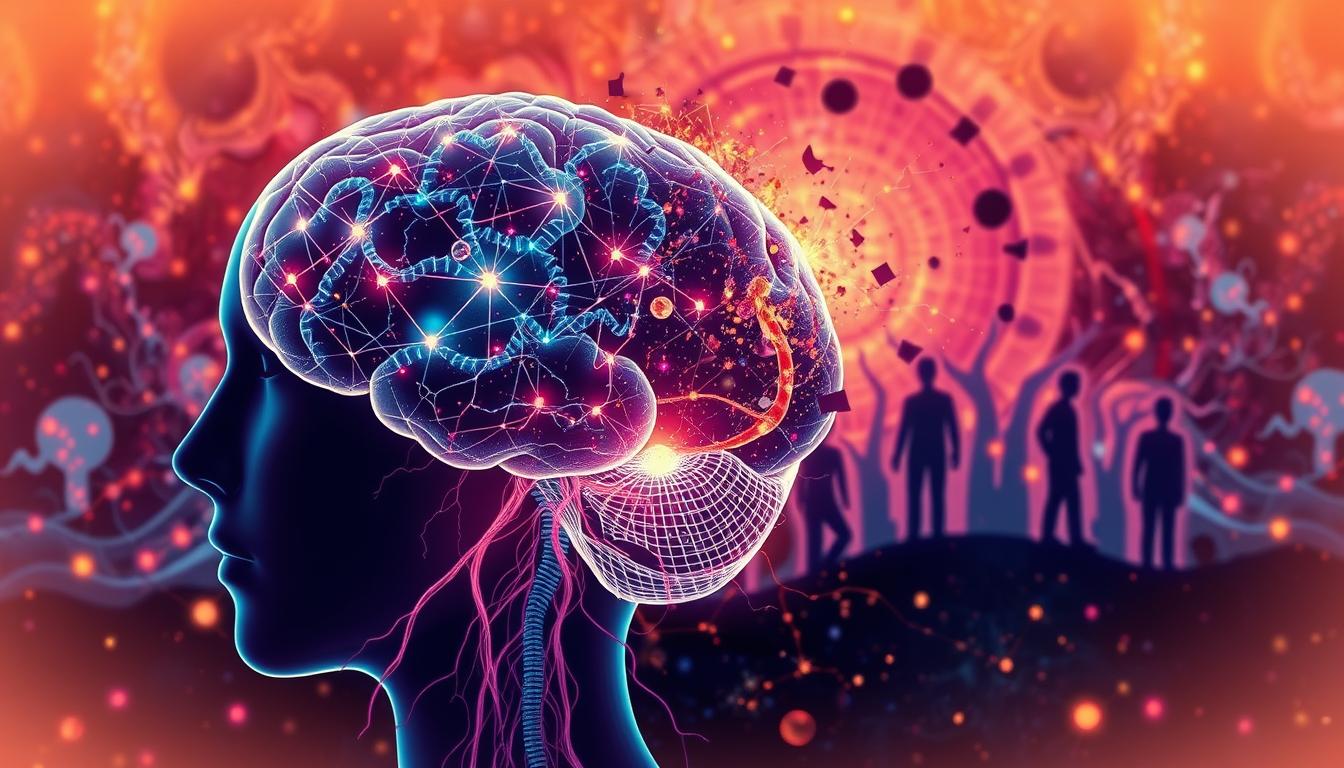
Your brain creates your self-image bit by bit. This mental picture is always changing, mixing up memories, plans, and views. Every thought shapes who you think you are, influencing how you see yourself and the world.
A 2021 study in Social Cognitive and Affective Neuroscience showed how the brain forms identity. It found that damage to the vmPFC makes it hard to see oneself in the future. This shows how our biology affects our self-awareness.
Healthy brains, on the other hand, focus more on themselves than others. This shows how our minds prioritize our own identity. The hippocampus also plays a part, linking future plans to past memories.
But, the self is not a fixed thing. It’s a story our brain makes from bits and pieces. As neuroscientist Bruce Hood says, it’s an illusion based on what we sense, not a constant core.
Understanding Identity: What Does It Mean?
Exploring the meaning of identity begins with its roots in thought and experience. It’s more than just labels; it’s the essence of how we see ourselves and the world. Before philosophers like Kant, people didn’t separate their inner thoughts from their external life. Today, we understand identity as a mix of self-concept and life events, along with social roles.
Think of personal identity as a mosaic. Each piece is made up of values, hobbies, and where you live. Social groups like family or cultural communities also shape this mosaic. For instance, your gender, religion, or job aren’t just categories; they’re parts of who you present to others.

Early childhood lays the first drafts of this story. Family interactions set the groundwork, and adolescence is a time for rewriting. Labels like “student” or “athlete” guide our behavior, but they don’t fully define us. Being flexible is key: holding onto labels too tightly can limit growth, while embracing change allows us to evolve.
Self-concept isn’t fixed. It’s shaped by everything from neighborhood to historical context. Having a strong sense of identity helps us make choices that feel true to ourselves. Without it, decisions might feel aimless, like drifting without a map.
The Role of Thoughts in Shaping Identity
Every day, your thought patterns quietly shape your identity beliefs. Think about this: studies show how daily habits, like exercise, change how we see ourselves. When you repeat negative thoughts, like “I’m not good at math,” they become part of your identity beliefs. But you can change them by choosing new thoughts.
James Clear’s Atomic Habits shows how small actions, like short workouts, can change your self-perception. For example, doing 10-minute workouts can make you see yourself as active.

Acceptance and Commitment Therapy (ACT) teaches us that negative thoughts can become self-fulfilling. Negative self-talk, based on past experiences, limits us. But, by changing our thoughts, like saying “I’m learning,” we can rewrite our mental story.
Research shows that positive thoughts can boost our health. For instance, positive self-talk can lower stress and strengthen our immune system. A student who changes from “I can’t do math” to “I’m figuring this out” creates new brain paths. This shows that our identity can change.
By journaling our thoughts, we can spot and change negative patterns. Our thoughts are not set in stone. They are tools we can shape.
Environment and Identity Formation
Think about where you grew up. The cultural identity you absorbed from family, friends, and community shapes how you view yourself. Environmental influence isn’t just about geography—it’s the blend of social norms, values, and daily interactions that mold your sense of self. From the classrooms you sat in to the streets you walked, these spaces act as silent teachers in the story of social identity formation.

Consider how a bustling city contrasts with a small town. Urban life might prioritize independence, while rural settings emphasize community bonds. These differences reflect contextual identity, where physical surroundings become part of your mental landscape. Schools, for instance, often reinforce societal binaries—good/bad, right/wrong—limiting students’ exploration of nuanced self-perceptions. A study by Proshansky shows place identity ties self-concept to environmental past, meaning your earliest environments leave lasting imprints.
Research by Dixon and Durrheim highlights how familiarity with a place shapes identity through four lenses: familiarity with surroundings, emotional connections, symbolic meanings attached to locations, and how those spaces enable goals. A teen in a marginalized neighborhood might internalize limited future visions if their environment lacks diverse role models. Schools fostering open dialogue—like those using Oyserman’s possible selves theory—help students see identities as fluid, not fixed.
Experiences that Mold Our Identity
Every moment in our lives, big or small, shapes who we are. A career change or a simple morning routine adds to our identity experiences. Big events like graduating or becoming a parent can change how we see ourselves instantly. Even daily routines and family traditions help build our
Think about how big moments like trauma or success can change us. Henri Tajfel’s Social Identity Theory explains how being part of a group affects how we see these moments. For example, losing a job might seem like failure to one person but a chance to start anew for another.
Childhood is also key. A supportive home environment helps us grow strong, while neglect can make it hard to accept ourselves.
Adolescents go through a time where figuring out who they are is key. School friends and family play big roles. Even what we see in ads or on social media shapes our self-image. But, mindfulness helps us look at past events in a new light, turning negatives into positives.
The Intersection of Identity and Personal Values
Your value-based identity begins with what truly matters to you. Core values like honesty, creativity, or justice shape how you see yourself and others. When your actions match these personal values, decisions feel real. But when they don’t, confusion sets in.
Imagine a teacher who values fairness facing a school that ignores marginalized voices. This mismatch causes stress.

Kimberlé Crenshaw’s work on intersectionality shows how identities blend. A Black woman’s identity alignment depends on her values and race, gender, and societal expectations. For example, valuing community might lead someone to support local programs, combining personal beliefs with social impact.
“Values are the compass guiding your choices.”
Trying new perspectives can realign your path. Journaling can help: What do you stand for? How do your daily habits reflect your core values? Small changes can show the gap between who you want to be and what you do now.
By living your values, you build a stronger, more purposeful sense of self.
Growth Mindset: Transforming Your Identity
Changing your mindset is the first step to transforming your identity. Seeing yourself as capable of growth opens up new possibilities. It’s like believing you can change who you are, allowing you to grow and adapt.
Studies show that mindset affects results. Students in growth mindset programs saw better grades, even those who struggled. Identity growth is a choice to keep learning and growing.
“The view you adopt for yourself profoundly affects the way you lead your life.”
Research shows how mindset shapes our reality. For instance, people who see stress as helpful have lower health risks. Placebo effects also show that beliefs can change outcomes.
Our brains can change with effort, proving fixed ideas about identity are myths. Cognitive therapy teaches that changing thoughts changes feelings. This is a key tool for growing your identity.
Global studies back this up. Over 500,000 students in PISA data linked growth mindset to better grades. Even small mindset shifts can make a difference, like a Stanford study found with math enrollment. But, success takes consistent practice. Mindset is not a quick fix—it’s a journey of curiosity about your own growth.
Embracing flexibility in self-concept means seeing setbacks as learning opportunities, not failures. Every challenge is a chance to refine your story. Your identity is not fixed—it’s a living, evolving process. Start today by asking, “What might I become if I keep learning?”
The Influence of Relationships on Identity
Our sense of self starts forming in childhood and grows with each connection we make. The people around us, like family and friends, shape our view of ourselves. Healthy relationships reflect our strengths and show us where we can grow.
Studies show that 70% of personal growth comes from good relationships. But, when others’ expectations clash with our values, it can cause tension. This tension comes from trying to balance our true selves with what others expect of us.
Have you ever felt forced to hide parts of yourself? This feeling shows how our identity can get mixed up with others’ opinions. More than 80% of people say their closest relationships shaped their core beliefs.
But, holding onto others’ views too much can make us lose touch with ourselves. Feeling ashamed or distant from a partner often happens when we ignore our own needs to please others.
Being kind to ourselves during conflicts can help us find our true self again. Building 15% of our connections with supportive people can help us understand who we are. Research shows that focusing on these bonds can make us 50% more confident in our identity.
Finding a balance between our social bonds and staying true to ourselves is hard. But it’s key to growing and staying connected to our core values.
The Ongoing Process of Identity Evolution
Identity is not set in stone; it changes as we go through life. Erik Erikson’s eight-stage theory shows how our sense of self grows through adulthood. Each stage offers a chance to redefine ourselves, whether through career changes or aging.
Adolescence and early adulthood are critical times. For example, college years are when many explore their vocational and relational choices. Yet, only 18% of young adults find strong commitments in both areas. This shows how our brains can adapt and change as we go through life.
Midlife brings new insights. Between ages 40 and 65, many reevaluate their goals and values. This is not a crisis but a natural part of growing and changing. Even in late life, people reflect on their experiences, leading to satisfaction, as Kroger’s research shows.
“Identity is a story we rewrite with each life chapter,” notes Erikson’s model, highlighting lifelong growth.
Societal changes also push us to evolve. With 0.6% of Americans identifying as transgender, modern identities are breaking free from old norms. Yet, 54% of people hold traditional views, showing how changing self-concepts challenge and expand our cultural stories.
Seeing identity evolution as a positive journey means viewing transitions as opportunities, not challenges. Whether adjusting to parenthood or retirement, being adaptable helps us stay resilient. Every stage of life is a chance to discover new parts of ourselves and who we’re becoming.
Strategies for Positive Identity Development
Building a strong positive self-concept begins with identity development strategies. These strategies turn self-awareness into action. Daily practices like journaling help track thoughts and align them with core values.
Mindfulness exercises calm the mind, making space to question automatic beliefs. Ask yourself: Are my thoughts facts, feelings, or assumptions? This simple check reduces confusion and boosts clarity.
Research shows identity practices like self-affirmation lower anxiety and improve focus. Writing about personal strengths for 15 minutes a week strengthens resilience. Pair this with seeking honest feedback from trusted friends or mentors—it highlights blind spots and reinforces growth.
Even small steps, like volunteering or joining clubs, connect actions to values. This shapes an intentional identity that evolves over time.
Remember, identity isn’t fixed. Teens who reflect on setbacks with curiosity, not criticism, build problem-solving skills. Celebrate small wins, like trying a new hobby or standing up for a belief. These moments prove your choices matter.
By balancing self-compassion with proactive steps, you create a foundation for lifelong adaptability. Your journey is unique, so let these strategies guide you toward a future where your choices reflect who you want to become.