
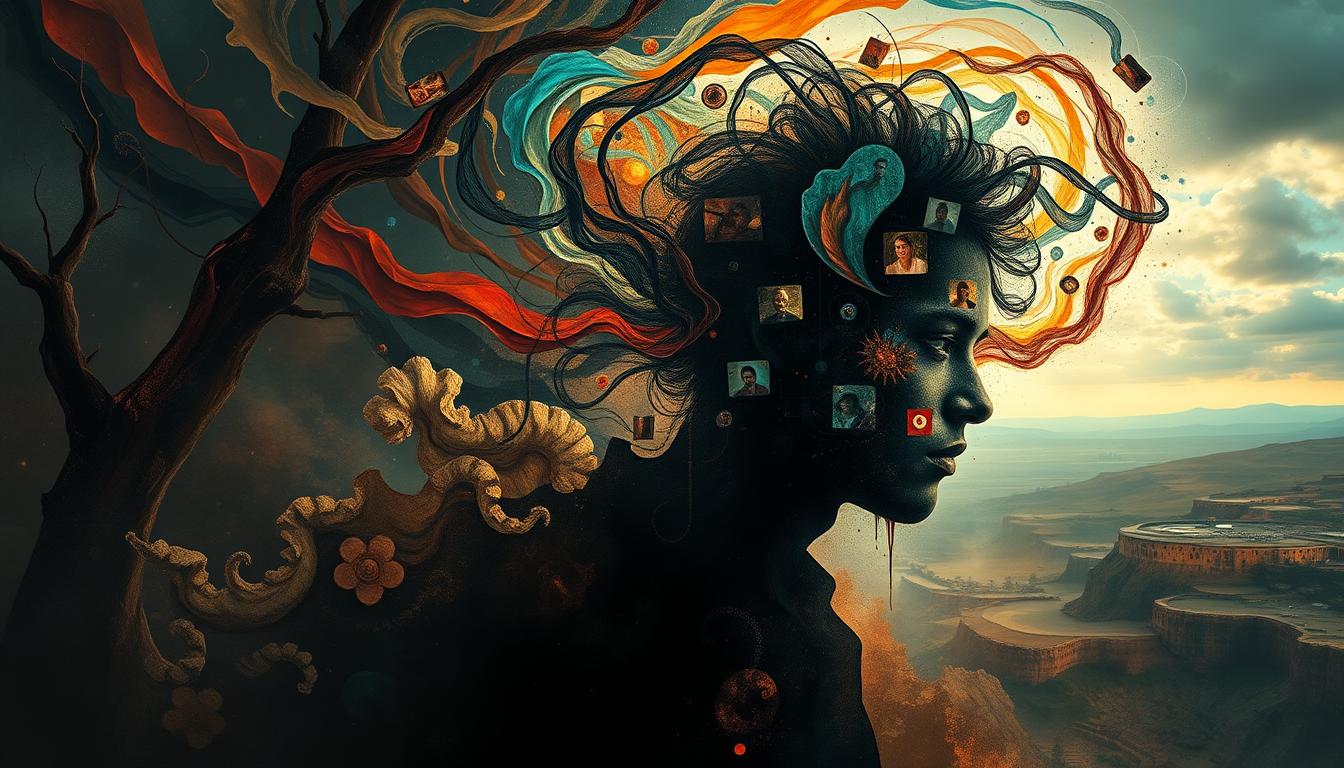
Our brains are hardwired to find and tell stories. This is a trait from our evolution. Narrative psychology reveals that stories are more than just fun—they help us understand the world.
Stories turn plain facts into meaningful experiences. They guide our choices and influence culture. This ability to make sense of things is a key part of being human.
From the start, stories helped humans survive. They shared dangers and solutions. This way of thinking helped solve problems and brought people together.
Today, this skill lets us dream up new ideas and connect with others. The stories we tell ourselves shape our view of reality. They influence how we see the world and interact with it.
The Power of Narrative in Human Experience
Stories are more than just tales; they are survival tools in our DNA. Narrative psychology shows how stories help us make sense of the world. They turn random events into meaningful journeys. Early humans used stories to warn, teach, and inspire, shaping human survival mechanisms before written language existed.
These shared tales brought social cohesion to tribes. They united people through shared fears, hopes, and values.
Research proves stories last longer than facts. In Breithaupt’s experiments, storytelling evolution showed emotional arcs stay vivid while details fade. Patterns like a hero’s journey or a villain’s defeat are common across cultures.
These patterns reflect how our brains process reality. When we hear a story, we imagine ourselves in it. This fosters empathy and connection. It’s how societies remember, adapt, and thrive.
Modern studies back this ancient truth. Redemptive narratives improve well-being by framing struggles as growth. On the other hand, fragmented or passive stories leave people feeling isolated. The brain reacts to exclusion like physical pain, showing stories are more than just words.
From ancient campfires to TikTok videos, storytelling is humanity’s way of sharing wisdom. It turns survival into shared knowledge.
“Stories are not decorations on the cake of life; they are the flour,” argues Breithaupt, highlighting how narratives let us “cook” meaning from life’s raw experiences.
Why We Connect with Stories
Stories are more than just fun—they feed our brains. Hearing a great story makes our brains release oxytocin, a hormone that builds trust and empathy. This oxytocin effect makes us really care about characters, even if they’re not real.
Neuroscientist Uri Hasson says, “A story is the only way to activate parts in the brain so a listener turns the story into their own idea and experience.”
“Stories about natural disasters, like tsunamis, can save lives by embedding survival lessons.”
Stories take us on a journey, making us forget about the real world. Think about reading a thriller and feeling the fear of the main character. This feeling helps us connect with the story’s characters.
Studies show we remember stories much better than facts. Even ancient Aboriginal myths, passed down for thousands of years, reflect real events. This shows stories are a powerful way to share knowledge.

Stories also change how we act. Health campaigns use stories to make us feel more empathy than just facts. When we see a character in trouble, our brains feel their emotions too.
This connection, called brain synchronization, is why we root for the underdog or cry at sad stories. Stories make abstract ideas feel real, preparing us for life’s challenges.
Stories as a Tool for Memory Retention
Stories do more than entertain; they change how we remember. Our brains naturally encode information in story form, making facts memorable. Research shows narrative learning techniques improve information retention by 22% over just facts.
“Memory is a creative act in which we subconsciously work to put things we’ve experienced into a resonable structure so that they stick.”
Think of algebra as a choice between $100/month or a penny doubling daily. This educational storytelling turns complex math into a fun puzzle. Archimedes’ famous “Eureka!” moment makes learning about buoyancy unforgettable.
Why does this method work? Stories engage brain areas linked to social interaction and emotion. A four-step structure helps the brain remember better. Even kids benefit from stories early on, improving their memory over time.
Corporate and classroom trainers apply these findings. DEI programs with personal stories see a 35% increase in engagement over lectures. Companies like Pixar and National Geographic show that memory enhancement storytelling works for everyone.
Cultural Narratives: Shaping Identity and Values
Cultural storytelling is key to a community’s identity, blending traditions into its fabric. It shapes how groups see themselves and the world. These stories start in childhood, passed down through generations, defining values and belonging.

“The single story creates stereotypes, and the problem with stereotypes is not that they are untrue, but that they are incomplete.”
In the U.S., the “American Dream” myth sees success as individual effort, hiding systemic barriers. Cultural heritage stories, like Choctaw myths or Hawaiian moʻolelo, keep history alive through oral tales. These stories highlight shared heritage, unlike myths that divide.
Griots in West Africa and Irish seanchaí used stories to record history. This shows how narratives guide and reflect us. When stories are not questioned, they can lead to exclusion.
The “pull yourself up by bootstraps” myth ignores policy’s role in opportunity. Changing these stories requires challenging deep beliefs. Stories like Passover’s Exodus teach values, showing how they evolve to reveal truth.
Valuing diverse cultural stories means hearing all voices. As communities share, identity grows, building empathy. This change is more than words; it’s rewriting systems to reflect human diversity.
The Science Behind Storytelling
Storytelling neuroscience shows how our brains narrative persuasion works. When we hear stories, areas like Broca’s and Wernicke’s light up. They process language and meaning.
Stories also turn on sensory and motor cortices. This creates vivid mental pictures. It makes information easier to remember and more emotionally impactful.
Stories release cortisol, boosting memory, and dopamine, which keeps us focused. Oxytocin, the empathy hormone, makes us connect with characters. It’s like they’re real.
Neuroimaging shows our brains respond to stories like real-life events. This “neural coupling” builds trust and connection between the storyteller and the audience.
Studies show fiction readers become more empathetic. This is because of mirror neuron activation. Stories with classic structures—goal, struggle, resolution—teach us lessons easily.
Brands like Nike use stories to inspire action. Even ancient epics, like the Epic of Gilgamesh, followed these principles. This shows storytelling’s lasting power.
The Role of Stories in Innovation
Stories are key to sparking innovation in teams. For years, myths made it seem only Silicon Valley innovated. But organizational storytelling shows anyone can lead change. At UNHCR, 15,000 staff worldwide now use stories to innovate, breaking old stereotypes.
In Brazil, UNHCR Innovation Fellows from one area shared their challenges. This led to solutions across borders. Creative problem-solving stories make complex ideas simple. When Qatar’s labor issues were exposed, a storytelling campaign pushed FIFA to change laws, showing stories can change systems.
The Oxford Futures Forum combines art and strategy through narrative innovation. The Tech for Good movement, with 6,000 UK members, links tech advancements to social good. Even “Ghost Boat” by Medium shows how stories can highlight refugee issues better than reports.
When teams ditch myths for creative problem-solving stories, they tap into everyone’s talent. The Ayni Institute says diverse voices in stories build stronger systems. By sharing successes and failures, teams create a culture where innovation is a shared language.
Storytelling in Marketing and Brand Building
Brand storytelling makes brands stand out in culture. Nike’s “Just Do It” campaign, with a $4.1 billion budget, turns sports gear into symbols of grit. It’s not just about selling shoes; it’s about motivating people.
Warby Parker links its glasses to a mission: for every pair sold, another is given. This helps 1 billion people without glasses. It makes customers feel part of something bigger. This builds loyalty beyond just the product.
Burt’s Bees Foundation invests $5 million in conservation. This ties their products to caring for the environment. It wins over eco-friendly shoppers, showing that stories of purpose build trust.
Even small details, like customer reviews, are important. 45% of shoppers avoid products without reviews. This shows how stories from others validate brands.
Podcasts and YouTube channels, like Airbnb’s 646,000-subscriber channel, show storytelling’s power online. People trust stories from others more than ads. Brands like Coca-Cola and Dove use relatable stories to connect with people. Good storytelling makes brands unforgettable.
Today’s consumers want to understand the meaning behind brands. Brands like Patagonia and Apple share their missions through stories. Storytelling is key in a world where trust is built on being real and caring.
The Impact of Stories on Perspective and Empathy
Stories are like mirrors and windows. They reflect our own lives and open doors to others. Narrative empathy grows when we dive into perspective-taking stories. This lets us see the world through someone else’s eyes.
Research shows that fiction reading boosts our understanding of others. People who read fiction do better on empathy tests than those who read non-fiction.

A 2013 study found that reading literary fiction improves our ability to understand emotions. For example, Harry Potter teaches us about friendship and prejudice. Students who read it showed more empathy for those who are different.
Reading Saffron Dreams, a story about a Muslim woman’s struggles, also reduced racial bias. These social change narratives show that empathetic storytelling can change our minds.
“Stories that challenge stereotypes create cognitive empathy, making the abstract tangible.”
But with this power comes a big responsibility. Creators must make sure their stories are true. Marginalized voices should tell their own stories to avoid stereotypes.
When done right, stories can bring people together. They can make us see others as part of our own community. In today’s divided world, this is a huge accomplishment.
Storytelling in the Digital Age
“The amount of information available is approaching a point where it exceeds the amount of attention we can give it.”
Today, digital storytelling tools help us deal with too much information. They make stories come alive and let us join in. YouTube and VR headsets let us dive into interactive narratives and choose our own paths.
These formats turn us from passive viewers into active participants. We explore virtual reality narratives and follow transmedia storytelling across different platforms.
At Molalla Elementary, students used animation to solve geometry problems through digital storytelling. The University of Alaska’s “Bob’s Battle” uses VR to teach about superbugs. These examples show how tech can blend art, science, and media.
But with AI creating content, it’s important to know what’s real. We need to think critically about the stories we hear.
Transmedia storytelling connects people worldwide, but algorithms can keep us in our own bubbles. Yet, tools like podcasts and VR give everyone a chance to be heard. The future of storytelling is about finding a balance between new ideas and keeping our stories real.
Developing Your Own Storytelling Skills
Learning storytelling techniques means knowing key elements: characters we can relate to, a clear conflict, and emotional stakes. Experts from Forbes Communications Council say successful stories rely on these. Start by watching stories that touch you. Think about what makes them stick in your mind.
Practice is essential. Storytelling practice means writing every day, even a little bit. Turn everyday moments into stories. Share them to see how others react. Most writers get better with regular writing.
Stay away from clichés and flat characters. Use feedback to make your stories better. Embrace doubt as a way to grow. 85% of writers use others’ success to motivate themselves. Try exercises like planning plot twists or dialogues to improve your communication skills storytelling.

Empathy-driven stories with vivid details boost retention by 40%. Multisensory descriptions—like the crunch of autumn leaves or a character’s nervous laugh—make scenes unforgettable.
Begin with a 500-word story focusing on one emotion. Share it, then revise it. Keep doing this to build your confidence and clarity. Remember, every storyteller started where you are now.
The Future of Storytelling in Society
Stories will keep changing with new technology. They will mix old and new trends. Virtual reality, AI, and augmented reality will change how we see stories.
These tools let us dive into stories, not just watch or read them. They bring new ways to tell tales. But, they must keep the emotional heart of stories alive.
Technology could also help us understand each other better. It makes complex ideas easier to grasp and share.
The future of stories needs to include everyone’s voice. The creator economy is growing fast, reaching $100 billion by 2023. This means more diverse stories for all.
Brands like Nike and Patagonia already use real stories from people. This shows we want genuine experiences, not just ads. The metaverse, with its 25% daily users by 2026, opens up new ways to share stories.
But, there are hurdles. Our attention spans are short, under three seconds. Storytellers must find new ways to keep us engaged. Yet, they must not lose the heart of the story.
Tools like scent marketing, which boosts sales by 11%, show stories can be more than words. Even with technology, connecting with others is key. John F. Kennedy’s moonshot speech shows how stories can inspire us to work together.
From ancient cave paintings to today’s algorithms, stories unite and inspire us. They help us solve problems and remember we are all in this together. Yuval Noah Harari in Sapiens says stories are our greatest strength. They will keep changing to meet our future needs.