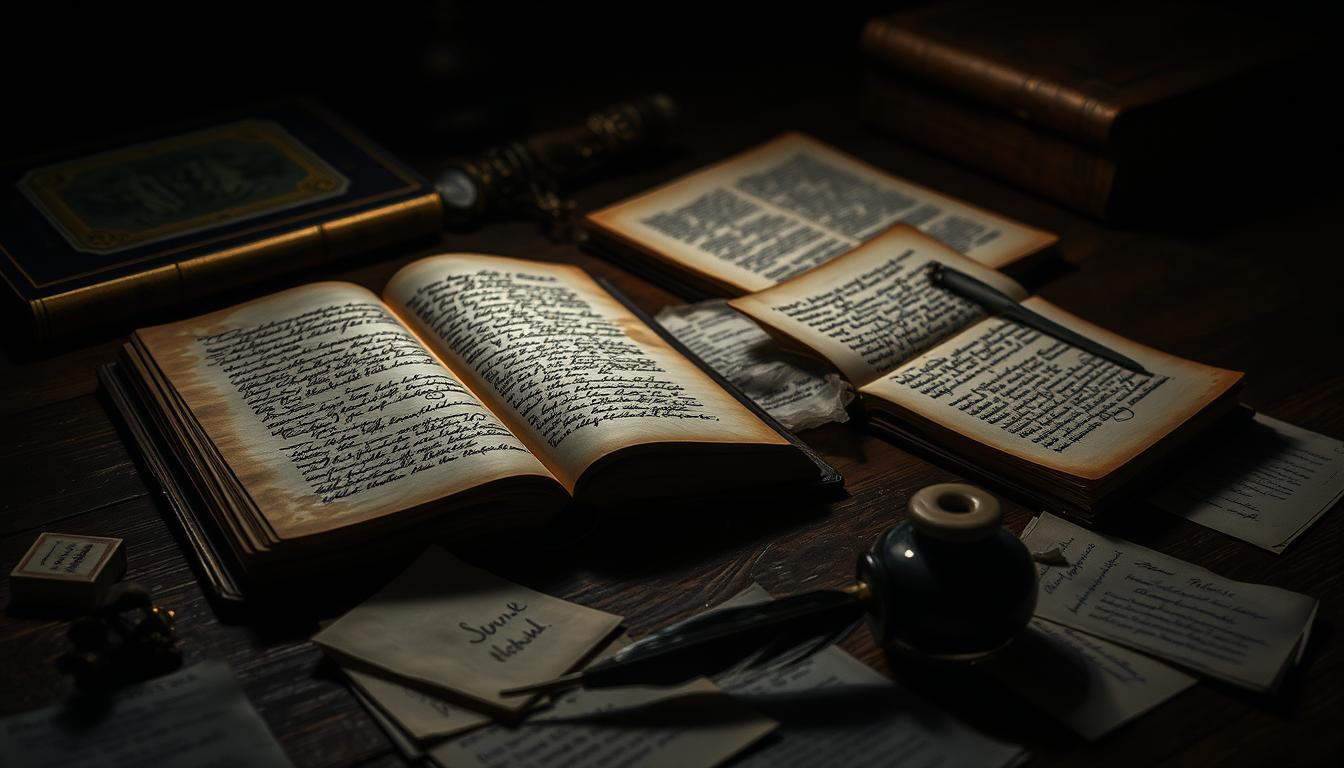
Imagine finding a diary hidden in a drawer. Would you read it? Secret journals are for the writer’s eyes only. Yet, over 70% of journal writers worry someone might find their fictional diary entries or real ones. Even ancient thinkers like Marcus Aurelius knew the value of private thoughts.
Today, 65% use passwords to keep their digital journals safe. This shows how much we value our privacy.
Reading someone’s diary isn’t just personal—it’s a peek into humanity. Books like Bridget Jones’s Diary and Gone Girl use secret journals to tell stories. But what if curiosity gets too much? This article looks at the line between privacy and curiosity, from ancient times to now.
The Allure of Reading a Secret Diary
For centuries, humans have been drawn to diary curiosity. Looking through someone else’s diary feels like entering a secret world. This allure comes from our desire to know what others think and feel.
Reading private thoughts gives us a raw look into someone’s mind. It’s a connection that casual talks can’t offer.
Sally MacNamara Ivey collected over 1,000 diaries for decades. Her work shows how diaries connect us across time and culture. Studies show that sharing diary entries can strengthen bonds and break down prejudices.
Virginia Woolf said diaries hold thoughts too private for public sharing. This makes them very interesting.
Diary curiosity isn’t new. People have kept inner lives documented for centuries. Today, the Great Diary Project has 17,000+ entries, showing this tradition continues. These writings show that feelings like joy and fear are universal, shared across time and places.
“No matter how separated we are by time and culture, we all share the same fears, hopes, and desires.”
This truth makes diaries so appealing. Each entry is a window into humanity’s shared heart. It invites us to see ourselves in others’ stories.
The History of Journaling and Diaries
Diary history shows us how ancient journaling began with practical records. The oldest diary, the Diary of Merer, dates back to the 15th century BCE. It tracked an Egyptian expedition. Early diaries were like work logs, like Abu Ali ibn al-Banna’s 11th-century entries on Islamic science.
As time went on, diaries became more personal. Marcus Aurelius’ Meditations mixed spiritual thoughts with everyday life. This shows how ancient journaling combined duty with self-reflection.

In the Middle Ages, scribes made diaries more detailed. The Journal d’un bourgeois de Paris (1409–1449) recorded war and daily life in Paris. It showed diaries could capture both big events and personal thoughts.
By the Renaissance, writers like Samuel Pepys (1660s) made personal entries vivid. Pepys’ accounts of the Great Fire of London are famous examples of historical diaries.
Modern journaling has grown with technology. In 1908, Smythson made the first portable diary book. Today, digital apps like Apple’s Notes and encrypted journals keep this tradition alive. From ancient scrolls to digital files, diaries keep our shared history alive.
Famous Diaries That Captivated Readers
Some famous diaries have become cultural milestones, giving us a peek into human experiences. Anne Frank’s diary, first published in 1947, is a key example. It has sold over 30 million copies, showing how a teenager’s story can touch hearts worldwide.
Historical journals like Samuel Pepys’ 17th-century writings or Leonardo da Vinci’s sketches mix daily life with genius. These records offer raw, unfiltered views often missing from textbooks. On the other hand, published diaries like Sylvia Plath’s or Andy Warhol’s 1978 entries show us the minds of celebrities, blending art with truth.
Some influential journals stand out for their sheer size. Claude Fredericks wrote 65,000 pages over 81 years, now at the Getty Research Institute. His entries span from 1932 to 2013, possibly the longest American life chronicle. Robert Shields’ 37 million-word diary and Arthur Inman’s 17 million-word volume also show humanity’s drive to document. These massive works, though private, are now cultural treasures.
“I believe that people are really good at heart.”
Even fictional published diaries like Sue Townsend’s Adrian Mole or Jodi Picoult’s Fictional Diaries are popular. They show the format’s enduring charm. From wartime stories to modern satire, these entries remind us that every life story can inspire, educate, and connect us.
Ethical Considerations in Reading Diaries
Diary ethics guide us on reading private journals. Curiosity can lead to privacy concerns, making it hard to know when to stop. The question lingers: Is it right to read someone’s diary without their diary consent? The debate is old, like the case of Anne Frank’s diary. Its publication raised questions about sharing personal thoughts for history’s sake.

Figures like Franz Kafka add to the complexity. He wanted his work destroyed, yet it became a literary treasure. Sylvia Plath’s journals also showed her personal battles, changing how we see her. These examples show the importance of privacy concerns when diaries are shared. Even authors like Emily Dickinson faced questions about keeping their words private.
Understanding others’ pain might build compassion, but without consent, it risks exploitation.
Modern bioethics, born from 1960s medical scandals, now guides research on vulnerable groups. Yet diary consent is a gray area. The story of Hanaoka Seishu’s wife, who tested anesthetic drugs in 1800s Japan, shows the risks of ignoring consent. Today, ethics committees demand openness in studies—should diaries get the same attention?
Ethical rules ask: Does sharing outweigh personal boundaries? The answer is not easy, but it begins with respecting diary consent. Every journal entry is a voice—whose story do we have the right to share?
Creative Uses of Fictional Diary Entries
Diary format storytelling grabs readers with its mix of truth and creativity. Books like Bridget Jones’s Diary and Diary of a Wimpy Kid show how diary entries can become hits. They let characters share secrets, making a deep bond with readers.
Authors create real diary voices by adding personal touches. The 2020 book A Diary in the Age of Water uses a 40-year diary to talk about climate change. It makes readers question what’s real and what’s not, showing the diary’s power.
Diaries can also tackle tough subjects. In Gone Girl, twisted entries expose a character’s true intentions. Even fake diaries, like the Diary of Anne Boleyn, start important discussions about truth in stories. Modern books like A Diary in the Age of Water include sketches, making the story feel more real.
Some books mix diary entries with third-person chapters. This approach gives readers two views of the story, making it more emotional. Diary writing is versatile, fitting into many genres from sci-fi to suspense.
Exercise Your Imagination: Writing Your Own Fictional Diary
Writing fictional diaries opens doors to new worlds. Start by creating a character’s voice. Think about what they care about, their fears, and quirks. Details like their job, relationships, and secrets are key to their development.
Would your character write about daily frustrations or grand dreams? Their entries show their personality, making them seem real.

“The Diary of a Young Girl taught us that even in darkness, words can shine.”
Try creative journal exercises to add authenticity. Mix everyday routines with important moments. A character might spill coffee on their desk one morning, then write about a big confession later.
Imaginary journal entries are all about imperfections. They might have crossed-out lines, abrupt endings, or messy thoughts. Let your character’s emotions guide the tone. It could be excitement, anger, or wonder.
Studies show daily writing boosts creativity and observational skills. Use these insights in your writing. Write a scene where your character faces conflict. How would they describe it? Try different perspectives.
A shy student’s diary might hide truths, while a bold artist’s pages might overflow with color. Start small. Write a single entry about a fictional day. Let your character grow over time. With patience, these entries could spark stories beyond the page. The journey starts with a single pen stroke.
How Fictional Diaries Can Influence Literature
Diary-format fiction has always connected personal stories with the art of storytelling. Bram Stoker’s Dracula and Samuel Richardson’s Pamela are great examples. They showed how diaries can pull readers into characters’ lives.
Dracula from 1897 mixed different diaries to create suspense. This method is now known as diary narrative techniques. It lets readers feel like they’re part of the story.
Today, books like Bridget Jones’s Diary and Gone Girl keep this format alive. In Gone Girl, Amy Dunne’s fake diary changes everything. It shows how diaries can surprise us.
Diary of a Wimpy Kid also uses diaries to make readers laugh and feel connected. It shows how diaries can reach out to different people.
Angela R. Hooks’ 2020 book, Diary as Literature Through the Lens of Multiculturalism in America (ISBN 978-1-62273-611-9), talks about diaries and diversity. It shows how diaries can share important stories that were once ignored.
Emily Brontë’s Wuthering Heights and Maid’s Diary are just a few examples of how diaries touch our hearts. They make us see the world from someone else’s perspective. This makes diary literature forever special.
The Impact of Digital Age on Diary Writing
Diaries used to be hidden away, but now they’re digital diaries and online journaling. Sites like blogs, Instagram, and apps like Day One let us share our thoughts right away. In 2000, scholar Philippe Lejeune saw early blogs as a “caricature” of private journals. But today, these modern diary formats are all the rage.
Social media has turned diary entries into public shows. It mixes personal thoughts with the need to impress others.

Now, diary writing happens in real-time. Teens share quick updates on TikTok or Twitter. Sherry Turkle’s work shows how social media makes us focus on quick posts over deep thoughts.
Fiction writers are catching up by using diary-style emails or Instagram posts. This shows how fast-paced life is today. But, this fast pace might make us lose the deep thinking that diaries were once known for.
Communities form around hashtags like #Journaling or #MindfulWriting. They offer support but also criticism. Brands like Penzu and OurJournal provide private spaces, but the urge to share publicly is strong.
While digital tools make writing more accessible, they also make it harder to keep thoughts private. The diary’s evolution is not just about technology. It’s a big change in how we share our innermost thoughts.
Popular Writing Prompts for Fictional Diaries
Exploring fictional journal ideas can turn blank pages into vivid stories. Start with diary character prompts like a time traveler adjusting to 2024 or a secret superhero masking their powers. These creative diary exercises help writers build authentic voices over time. Imagine entries from an explorer mapping uncharted lands or a witness to a key historical moment—each scenario offers rich material for character growth.
Over 500 diary writing prompts exist to spark ideas, from supernatural dilemmas to survival stories. Data shows 80% of writers use prompts to overcome blocks, while 20% of publishing success stems from raw talent and 80% from daily practice. Try prompts like: “Describe a day in a world where time moves backward” or “Log interactions in a community that bans emotions.”
Writing coaches like Laura Mae Isaacman recommend blending personal reflection with fictional scenarios. The Reedsy contest rewards short stories based on diary entries, proving their value in storytelling. Pairing prompts with real-world themes—like analyzing a book’s structure—can boost narrative skills by 50%, per studies. Whether crafting a spy’s coded notes or a AI’s first thoughts, these exercises turn imagination into tangible tales.
Conclusion: The Lasting Appeal of Secret Journals
Secret journals are a window into our souls, showing both our private and shared sides. Alba de Céspedes’ Forbidden Notebook was found in Iran decades after it was first published in 1952. It tells the story of Valeria Cossati, who wrote during Italy’s fascist era. Her diary touched Iranian women in the 2000s, showing the diary’s universal appeal.
Ann Goldstein’s recent translation of the Forbidden Notebook brings it to a new audience. Pushkin Press plans to release more of De Céspedes’ works by 2024. This shows how secret journals can connect us across time and cultures.
The authenticity of secret journals is key. The Anne Frank House fought legal battles to prove her diary was real. A 1986 forensic report confirmed her diary was written in 1942–1944. This highlights the diary’s power to share real stories.
Even fictional works like Dracula and Guernsey Literary Society use diary formats. They blend fiction and reality, inviting us to explore their stories. This lets us see the world through different eyes, whether through old letters or modern blogs.
Writing your own diary can be a powerful way to reflect. Let a blank page become a bridge to understanding yourself and others. The stories in personal writings keep history alive, connecting us all.