
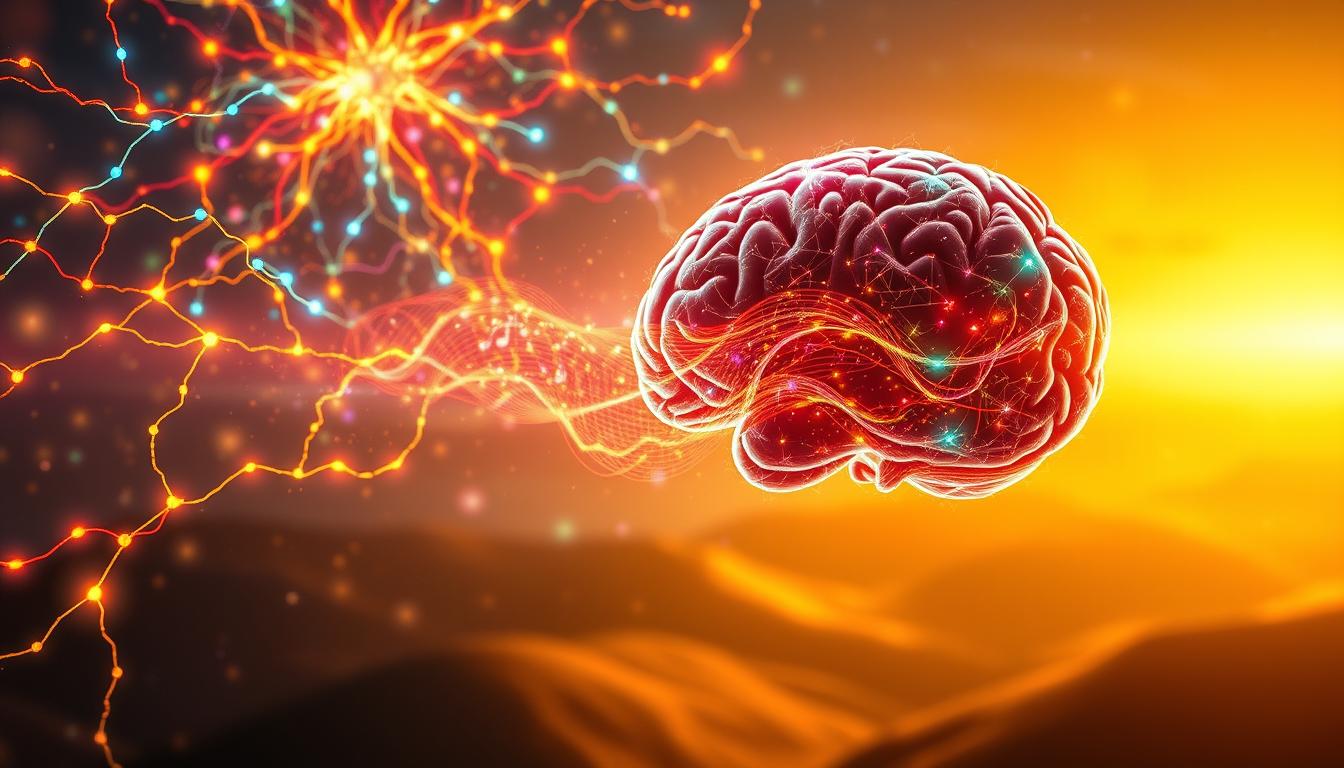
Music isn’t just background noise—it’s a language that speaks directly to the brain. The music and brain relationship starts with sound waves turning into electrical signals. These signals wake up brain areas linked to emotion and memory, forming the brain music connection that shapes our thoughts and feelings.
Every note and rhythm leaves its mark. From the chills of a favorite song to the motivation of a workout playlist, music has a profound effect.
Science shows why this happens. When we hear music, the limbic system—a network managing emotions and memories—gets active. Dopamine release during pleasurable tunes boosts our mood, focus, and motivation.
Even the shivers from a powerful melody are linked to this biological response. Whether calming anxiety or fueling energy, music’s impact is both universal and deeply personal.
The Science Behind Music and Mood
Sound waves start as vibrations in the air. They enter our ears and send electrical signals to the brain. The brain’s amygdala and hippocampus then process these signals, affecting our mood.
Studies show that our favorite songs make the brain release dopamine, a happiness chemical. This is why we often feel chills or goosebumps when we hear certain songs. A 2012 study found that people rarely stay neutral when listening to music, showing its strong emotional impact.
Music can also change our body’s physical state. Fast beats make our heart rate go up, while slow melodies help us breathe more calmly. Scientists are even using music to help treat depression, showing its power to change our brain’s pathways.
Historical Perspectives on Music’s Power
Long before music psychology became a field, ancient cultures knew music’s emotional power. Greek philosophers like Aristotle believed music could shape morality. They thought certain melodies could teach virtue. In medieval Europe, Gregorian chants brought people together, fostering spiritual connection through sound.
These early uses of music laid the foundation for today’s music therapy benefits. They show how music can influence our thoughts and feelings.
Healing with music has been around for thousands of years. Egyptian healers used flutes to calm the anxious. Indigenous cultures worldwide used drums in rituals to restore balance. These practices are now backed by science, showing how rhythm affects our brainwaves.
Renaissance courts used dance and song to build diplomacy. This shows music’s ability to bring people together, long before songs like “We Shall Overcome” united the Civil Rights movement.

Baroque composers like Bach created complex music to inspire awe. Modern research shows that music can light up 90% of our brain. Even military marches were used to boost courage, showing music’s mood-altering effects.
Studies like the 2011 University of Groningen research found that upbeat melodies make us 40% quicker to spot happy faces. This proves ancient wisdom has a scientific basis.
From ancient Greek lyres to modern therapy sessions, music’s power remains. Its historical uses, from soothing infants to uniting nations, show ancient intuition aligns with today’s music psychology research. This legacy reminds us that music’s influence on thought is timeless and transformative.
Music Genres and Their Psychological Effects
Music genres affect how our brains handle sound and feelings. Music cognition studies show that genres like classical or jazz, with their complex sounds, spark creativity. Low-frequency sounds, found in ambient music, slow down our heart rates, helping us relax.
Faster beats in pop or electronic music, on the other hand, make us more alert. This is because they release dopamine, which boosts energy. That’s why upbeat music is great for workouts or when we need to focus.
Research finds that classical music can improve spatial reasoning, known as the “Mozart Effect.” Slow melodies, like those in blues or folk, release oxytocin, reducing stress. More than 60% of people say their favorite music helps them concentrate, showing how familiar rhythms can keep us focused.
Rock or hip-hop’s energetic beats get our hearts racing, increasing energy. Meditation music, with its steady tones, helps us relax. Jazz’s improvisation encourages creativity, while folk’s storytelling builds empathy. These show how music cognition changes based on the genre.
When picking a playlist, think about how its rhythms and sounds affect your mood. Whether it’s calming or energizing, every genre connects with our brain’s auditory processing. It turns sound into emotion and thought.
How Music is Used in Therapy
Sound therapy uses vibrations and rhythms to heal both mind and body. It ranges from ancient singing bowls to modern binaural beats. These methods help reduce stress and improve mental health.
Music therapy benefits extend beyond relaxation. It aids recovery for physical injuries and neurological conditions. Certified professionals guide sessions tailored to individual needs, blending melody and rhythm into personalized care plans.
Music therapists undergo rigorous training: a bachelor’s degree requires 1,200 clinical hours. This ensures they have the expertise to apply music to therapeutic goals. The Certification Board for Music Therapists offers the MT-BC credential, recognized nationwide.
This science-backed practice helps people of all ages. From children with autism to seniors with dementia, it makes a difference. For example, a 3-year-old nonverbal child with apraxia gained speech skills after 24 sessions, transforming her ability to communicate.

Music therapy benefits mental health by lowering anxiety and boosting self-esteem. Schools using music programs report higher graduation rates and fewer behavioral issues. In hospitals, it aids pain management and emotional recovery.
Studies show 90% of participants experience improved relationships and emotional well-being. Techniques like rhythmic auditory stimulation help stroke survivors regain movement. This proves music’s physical impact too.
Whether in group settings or one-on-one, music therapy adapts to anyone’s abilities. It’s not just background noise—it’s a tool for healing. The American Music Therapy Association lists accredited programs, making it easier to find qualified practitioners.
By harnessing sound, therapists unlock pathways to better health and connection. This proves music’s timeless power to heal.
The Impact of Lyrics on Thoughts
Lyrics connect sound and meaning, influencing our minds through music psychology. When we hear words with music, our brains react in special ways. Studies show that lyrics activate areas linked to language and memory.
This connection is why we remember song lyrics for years. It’s like recalling a first concert or a childhood favorite.
Music’s emotional impact grows when lyrics match the melody. Sad songs with detailed words make us feel deeper emotions. Happy songs with upbeat lyrics motivate us.
Research shows that happy music with lyrics grabs our attention better. Sad songs, on the other hand, engage parts of the brain related to thinking and feeling for others.
Ever thought you heard something different in a song? These “mondegreens” show how our brains seek meaning. When words don’t match the melody, we try to make sense of it.
This struggle between sound and sense makes lyrics very powerful. Therapists use songwriting to help people express their feelings. They use music psychology to improve self-expression.
Lyrics also influence our attitudes. Uplifting lines can boost our confidence. Nostalgic songs can bring back memories.
With streaming platforms now showing lyrics, their impact is even greater. Whether it’s uplifting or thought-provoking, lyrics shape our thoughts, feelings, and memories.
Music’s Role in Motivation and Productivity
Music and brain activity work together to fuel daily tasks. Uptempo rhythms boost energy, while calming melodies sharpen focus. Studies show instrumental tracks reduce stress, letting workers tackle repetitive jobs faster and with fewer errors. Music mood effects also drive motivation—employees who use playlists report higher job satisfaction.
“Emotional use of music boosts performance through job satisfaction, but background music can sometimes hinder focus,” noted a study of 244 workers. Over 57% listen to music while working, with headphones or office speakers as top choices.

Companies like Bose use ambient sounds to improve focus during tasks, while Google’s jam sessions boost teamwork. Research in Nature found instrumental music increases accuracy in detail-oriented work, while fast-paced beats help physical tasks. But, loud noise above 95 dBA harms concentration, raising cognitive strain.
Choose music based on the task. Lyrics interfere with reading, so opt for classical or ambient during reports. High-energy tracks suit meetings or brainstorming. Familiar songs cut distractions, while moderate volume keeps music a helper, not a hindrance. Introverts often prefer quiet, while extroverts thrive with background beats.
Future offices may feature music zones—creative spaces with curated playlists. Apps like Spotify for Work offer tailored tracks to match project phases. Pairing music with wellness programs could lower stress and sharpen creativity, turning workspaces into hubs of inspired productivity.
The Influence of Music on Learning
Music learning effects go beyond just rhythm. They shape how we process information. Scientists say music cognition is similar to how our brains handle language. When we hear a melody, it activates the same neural pathways as reading and problem-solving.
“The mental processes involved in knitting individual sounds together into the song’s perception are akin to decoding sentences,”
Studies show kids who learn music do better in math and reading. The Mozart effect found students did better after listening to classical music. This shows that background music can help with focus during tasks.
But not all music is good for learning. Loud or music with lyrics can distract. Soft instrumental music, on the other hand, helps us concentrate. Research also shows that instrumental music reduces cognitive load, helping us remember more.
Working memory is important. Music that matches the task’s difficulty helps us remember better. For example, the alphabet song helps kids remember the alphabet. Even adults who play instruments stay sharp. But too complex music can make it hard to focus, showing we need a balance.
Teachers and students can use this knowledge. Playing quiet, familiar tunes during study sessions can help. For harder tasks, silence might be better. Music is not a one-size-fits-all solution, but it can definitely help with learning.
Cultural Differences in Music Perception
Music affects our minds in ways influenced by biology and culture. While auditory processing of basic sounds like rhythm is universal, music psychological effects vary greatly. For example, the Tsimane’ people of Bolivia have different musical tastes than Westerners.
Westerners find it hard to repeat melodies in different octaves. But Tsimane’ people focus more on rhythmic patterns. Both groups, though, have limits in recognizing pitch, like the highest note on a piano.

In 2016, research showed Tsimane’ people enjoyed dissonant chords that Westerners found unpleasant. This shows how music psychological effects depend on what we’re used to. Rhythm preferences also differ: Tsimane’ like simple ratios, while Westerners prefer more complex ones.
This study, published in Current Biology, was funded by the James S. McDonnell Foundation. It found that biology sets limits, like pitch ranges, but culture shapes our emotional responses. Even ancient music, like flutes from Germany, shows we share some musical roots. Today, our world mixes traditions, creating new sounds. Understanding these differences helps us see how music connects and divides us.
The Future of Music Technology
Sound therapy and the brain music connection are key to new tech. A study in Brain showed music helps stroke survivors remember words better. Now, technology is taking this even further.
Adults who listened to music daily after a stroke showed significant gains in verbal memory compared to those using audiobooks or no audio.
Neurofeedback systems turn brainwaves into music, changing tunes to help you focus or relax. Imagine wearing headphones that adjust to your brain’s rhythm. This tech is being tested.
AI is making music production easier, and apps like Spotify create playlists based on your mood. Virtual reality concerts are becoming a reality, with Gorillaz’s VR video Saturnz Barz getting 15 million views.
Blockchain could soon make it easier to track royalties, ensuring artists get paid fairly. Hyperpop’s rise shows how tech lets anyone create music, like with GarageBand.
But there are challenges too. Privacy issues come up with brainwave-reading tech. Who owns music made from brain signals? Ethicists are discussing this as startups like MelodyVR sell VR concert tickets.
Yet, the possibilities are endless. Imagine personalized sound therapy for anxiety or AI music that changes based on your mood. Streaming giants like Spotify are investing in spatial audio, merging science and art in music.
From healing with sound waves to VR concerts, music tech is changing how we experience music. The big question? Will your next playlist be made by AI or your own brainwaves?
Conclusion: Embracing Music’s Power
Music’s effect on our minds is a mix of science and art. Studies reveal music therapy benefits for those with PTSD or dementia. For example, music programs helped dementia patients with verbal skills and children with focus.
Even simple acts like listening to happy tunes can improve our mood. It does this by connecting brain neurons with rhythms. This can help us focus or relax. The music and brain connection is fascinating, but its full power is yet to be discovered.
Research from Finland shows music training can improve reading in kids. Australian studies found active music engagement boosts well-being. These findings highlight music’s role in brain development and emotional health.
Short daily moments, like picking uplifting playlists or joining music groups, can make a big difference.
Science is learning how melodies shape our thoughts, but you don’t need a PhD to enjoy it. Music can ease stress, boost workouts, or bring people together. A study found even 0.5 hours of weekly practice can improve verbal skills and brain connections.
Let curiosity lead you to explore different music genres, try instruments, or join choirs. Music’s ancient, universal language offers ways to enhance our daily lives. It brings joy and proven benefits for our minds and emotions.