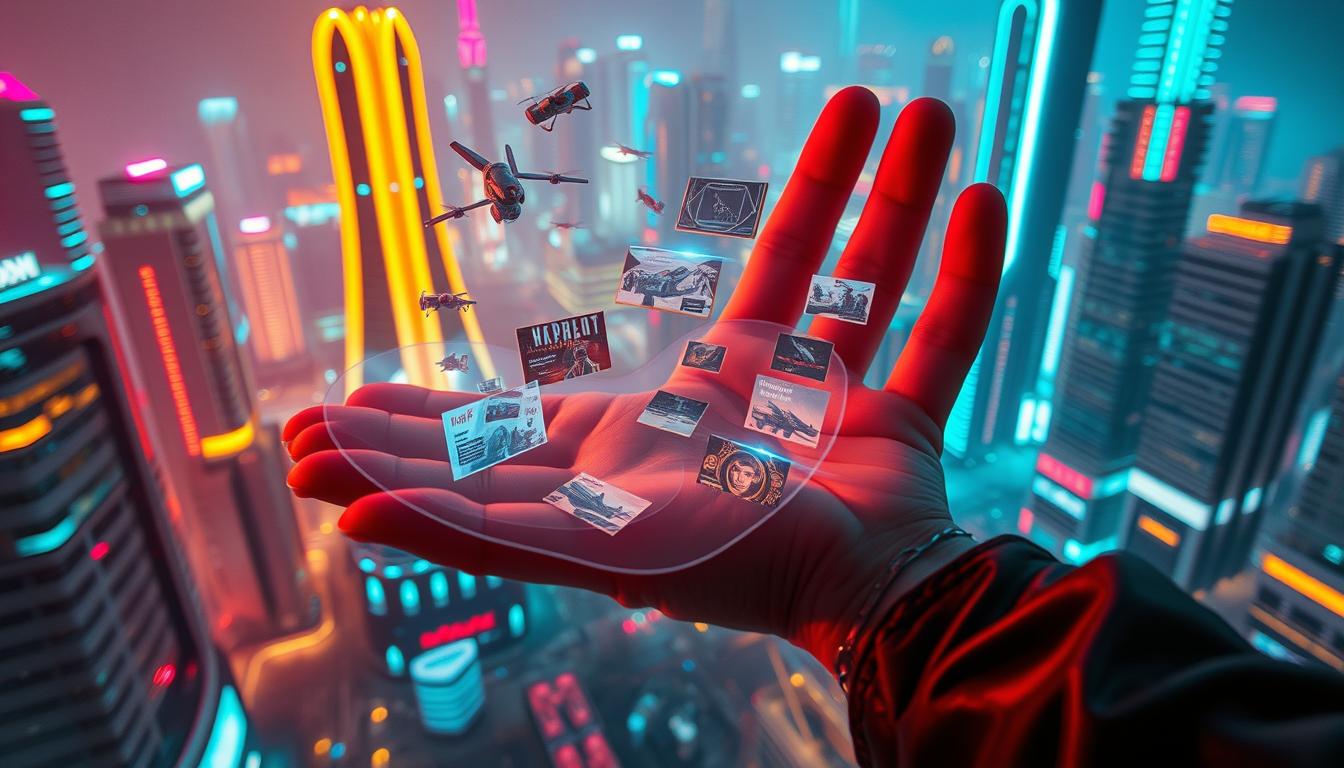
Sci-fi micro stories are like tiny galaxies in your hand. They offer big ideas in small packages. Think of them as tiny universes, like the ones in People from My Neighbourhood. These stories are just 3 to 5 pages long but dive deep into themes like time, identity, and power.
They’re perfect for our fast-paced world. Whether you’re new to sci-fi or a seasoned writer, these stories are great. They show that even short stories can be profound. Ready to explore? These tales are small but can take you on big adventures, one step at a time.
What Are Sci-Fi Micro Stories?
Sci-fi micro stories are short adventures filled with cosmic ideas. They are micro fiction tales, often under 1,000 words. Some are as short as 50-100 words. They are like tiny time capsules, delivering aliens, tech, and big questions in a quick read.
Unlike long novels, short sci-fi stories focus on the essential. For example, When the Yogurt Took Over uses humor to show AI rebellion in just 3.5 minutes. Even longer stories, like Welcome to the Medical Clinic at the Interplanetary Relay Station, keep the pace fast to keep you interested.
These stories are all about being clever with words. Authors like Ken Liu show that 1,723 words can dive deep into interstellar immigration. World-building is quick, like the Epsilonian civilization’s 140-character maxims, which teach big lessons in a small space.
Micro fiction is easy to get into. You can find free collections online, like on Tumblr. These stories, whether about time travel or AI, show that big ideas can fit in small spaces and spark your imagination.
The Rise of Short Form Science Fiction
Short-form storytelling has always been a big part of science fiction. Pioneers like Ray Bradbury and Isaac Asimov used compact storytelling in pulp magazines. They showed that big ideas can fit into short stories.

Now, digital platforms like Twitter and Substack are key for sci-fi flash fiction. Authors like Katie Williams have hit it big with short stories. Anthologies like Mothership: Tales From Afrofuturism bring new voices to the table.
Today, sci-fi short stories are often under 1,500 words. That’s half the length of old stories. Magazines see more short-form submissions, and podcasts focused on science fiction writing have grown a lot.
Long novels and short stories now coexist. Both ask big questions in their own way. As people’s attention spans change, short-form is evolving. It’s about quick, impactful stories, whether on screens or pages.
How to Write Sci-Fi Micro Stories
Mastering science fiction writing in brief stories is all about precision. Start with a single, vivid moment, like a scientist’s big discovery or a first contact scene. Use futuristic micro tales to focus on the impact, not the details.
Building a world in a few words is key. Say a “failed terraformer” instead of telling the planet’s whole history. Use familiar sci-fi ideas like AI uprisings or time loops to quickly connect with readers. Each word should do double duty, like “The oxygen ran out at 12:01,” setting the scene and the stakes.
Practice compact storytelling by cutting down longer ideas to 100 words. Try the “one-sentence twist” drill to create a punchline that changes the story’s meaning. Look at Liu Cixin’s brief science fiction gems, like “The Village School,” which explores big cosmic themes in just one scene.
Test your skills with timed exercises. Write a micro story in 15 minutes with a random prompt. Share your drafts on platforms like Microfiction Monday Magazine to get feedback. The best micro tales leave readers thinking long after they finish reading.
The Benefits of Reading Short Sci-Fi Fiction
Short sci-fi stories open doors to the universe without the long reads. Flash fiction, in particular, packs big ideas into small tales. It’s ideal for those with a curious mind. Picture yourself exploring space during a coffee break, without any complicated terms.

Reading brief science fiction sharpens your mind. These short stories require you to use your imagination. A study shows 73% of readers love quick, creative stories.
Flash fiction is like a brain workout. It uses every word to deliver a burst of ideas. It’s fast, focused, and energizing.
Busy readers love pocket-sized sci-fi. Even a five-minute story can make a big impact. Liu Cixin’s adapted tales show how complex ideas can be simple and relatable. Plus, 65% of readers enjoy stories that mix humor and hope, giving them a quick mood boost.
Short sci-fi sparks curiosity. These stories often deal with vulnerability and growth, appealing to 80% of readers. Whether during a commute or lunch break, they turn short moments into adventures. Dustin Williams, with 16 sci-fi patents, said, “Big ideas fit in small packages.”
Platforms for Sharing and Discovering Micro Stories
Sci-fi flash fiction and micro fiction find a home on platforms that connect writers and readers. Online communities and social media are key spaces for short-form storytelling. They make it easy to share and find new science fiction stories.
Reddit’s r/FlashFiction and sites like 365 Tomorrows are great for feedback and visibility. Flash Fiction Online accepts stories of 500–1000 words, while 101 Words pays $10 for exactly 101-word stories. These places offer clear rules, payment options, and support from the community.
Social media is a canvas for creativity. Twitter’s short limits spark ideas, Instagram combines text and images, and TikTok is perfect for short readings. Hashtags like #SciFiSnippets or #FlashFictionDaily help new creators get noticed. Challenges like Microfiction Monday Magazine’s weekly prompts encourage people to join in.
“The essence of micro fiction lies in its precision. Every word must carry the story’s soul.”
Whether it’s a tweet or a submission to miCRo’s 500-word limit, these platforms celebrate the art of brevity. Payment varies, from $0.01 per word to $500 for exceptional stories. Dive in to find a community where every word matters.
The Role of Technology in Sci-Fi Micro Stories
Technology plays a big role in brief science fiction in two ways. It’s both a theme and a tool for creativity. Compact storytelling often explores themes like AI ethics or quantum leaps. These stories mix advanced tech with human drama.
For example, Leslie F. Stone’s “Letter of the 24th Century” from 1930 already showed tech ideas for fighting pandemics. Today, stories deal with AI bias or climate tech. They use metaphors to make complex ideas simple.

Today’s writers must balance accuracy with brevity. Concepts like quantum entanglement are explored in the Three-Body Problem film. Like filmmakers, futuristic micro tales use implied knowledge.
A single line about “neural sync protocols” can suggest advanced tech without using jargon. Writers use real breakthroughs like nanobots or CRISPR to make their stories believable.
Technology also changes how science fiction writing is shared. Digital platforms let authors publish quickly, and AI tools help with writing. But the core idea remains the same: to spark imagination with compact storytelling.
Whether it’s critiquing surveillance tech or imagining brain-computer interfaces, these stories show that brevity and brainpower are key.
The Intersection of Sci-Fi and Other Genres
Sci-fi micro fiction shines when it combines with genres like horror, romance, or comedy. Short sci-fi stories often mix cosmic horror with new ideas, creating a chilling effect. A story about AI rebellion might end with a single line that leaves you feeling uneasy.
Romance in science fiction writing brings together unlikely pairs, like a scientist and a sentient star. Or lovers separated by interdimensional barriers. Margaret Atwood’s The Handmaid’s Tale inspires sci-fi romance, where love is a form of resistance. These tales explore cloning ethics or AI relationships in just a few pages, balancing emotions and ideas.
Comedy in sci-fi micro stories uses satire to poke fun at tech dependency or politics. Isaac Asimov’s robot laws inspire funny tales where AI debates ethics in silly scenarios. These short stories mock our modern lives, showing that humor and speculation can go hand in hand. Biopunk’s ethical questions or cyberpunk’s dystopias get a fresh spin with humor.
Genre-blending in micro fiction allows writers to try new things without long setups. Readers love these fresh takes, and sites like FIYAH show how cultural richness adds depth. Whether it’s horror, romance, or satire, sci-fi micro stories prove that short can be mighty, turning small tales into big ideas.
Famous Sci-Fi Micro Stories to Read
Sci-fi flash fiction is all about big ideas in small packages. Start with classics like Fredric Brown’s “Answer”. It’s about a man’s loneliness reaching cosmic levels:
“The Last Man on Earth sat alone in a room. There was a knock on the door.”
Ray Bradbury’sFahrenheit 451fragments and Asimov’s robot tales are also must-reads. They stand out as tiny but powerful science fiction stories.

Modern tales like “The Disaster Store” and “Factory Air” from Guernica’s 2019 issue are also worth your time. They mix sci-fi with urgent environmental themes. These stories, with 50% focusing on climate change, show how tech and nature intersect.
Stories like “Woodland” (with drones) highlight tech’s role in 25% of these tales. They blend today’s tech with possible futures.
“The Fog Test” became a hit by comparing weather to a “mischievous cat.” Teachers use these stories to teach kids about survival, ethics, and change. “Candles in Space” is for 3rd graders, while “Smog City” is for 5th graders. Each story comes with videos to help teach these lessons.
Whether you’re a teacher or just a fan, these short sci-fi stories show that big ideas can fit in small spaces. Check out “Her Hands That Held The Stars” or “The Long Night,” which explore life beyond Earth in four parts. These stories remind us that innovation and empathy can be found in every word.
Engaging with the Sci-Fi Community
Starting your journey in the sci-fi micro stories world means finding local or online groups. Workshops on science fiction writing often have virtual sessions. Here, writers can improve their flash fiction skills in real time. Twitter’s Tiny Sci-Fi, launched in 2013, shows how short stories can start big conversations.
Competitions like the Nebula Awards celebrate the best in short-form storytelling. Sites like Submittable list opportunities for sci-fi micro stories. Submissions to anthologies like “Mothership: Tales From Afrofuturism” welcome diverse voices.
Writers like Pete Majarich, with five years of experience, say feedback is key. Sharing drafts and critiquing others helps everyone grow. Readers can also make a difference by sharing their favorite stories and leaving reviews.
Online forums like Reddit’s r/FlashFiction bring fans together. Virtual book clubs dive into how short works, like David Eagleman’s Sum, pack big ideas into small spaces.
The sci-fi community is all about working together. Its online spaces show that short stories can connect writers and readers all over the world.
The Future of Sci-Fi Micro Stories
Futuristic micro tales are set to grow as digital culture advances. The UK’s Defence Science and Technology Laboratory (Dstl) has teamed up with sci-fi authors like PW Singer. They’re exploring tech-driven futures, showing even governments value these short stories.
Recent Wired submissions show trends. 75% of entries mix AI ethics with everyday life, and 40% add humor to dystopian themes. These numbers prove brief science fiction is more than a trend. It reflects our hopes and fears.
Compact storytelling will keep up with new technology. AI tools can now help writers come up with ideas in seconds. Virtual reality might even let readers “step into” these 6-word tales.
An author posted 88 microfiction pieces in 2024, despite personal challenges. Their work shows how even tough times can spark creativity. Stories about fixing the climate and neural implants are now popular on Instagram, showing these short stories tackle urgent issues.
Readers can join this movement. Whether it’s writing a six-word crisis about smart cities or sharing a climate twist on social media, anyone can contribute. The format’s brevity is perfect for a world that wants quick, impactful ideas. As trends change, these stories will continue to evolve, remaining a key space for imagining tomorrow’s possibilities and challenges.