
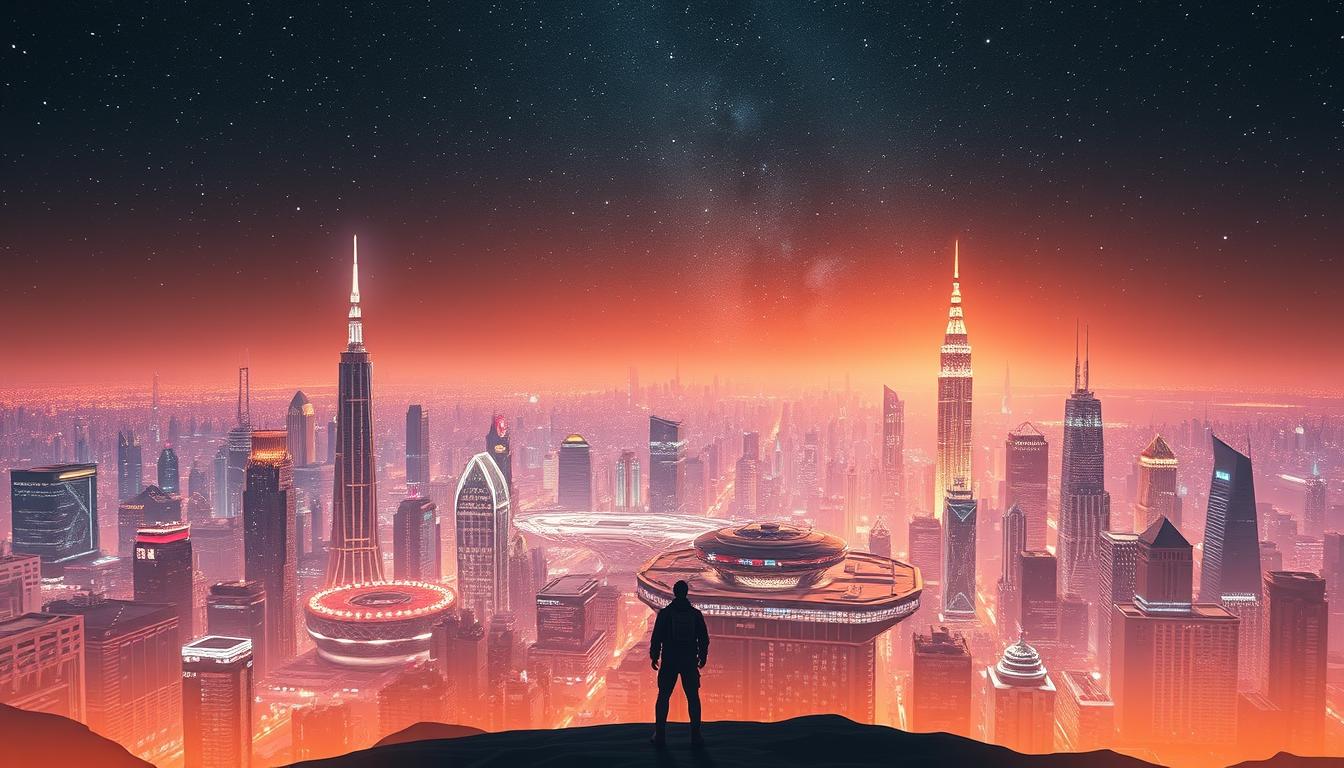
Imagine shrinking entire galaxies, time wars, and alien worlds into just one sentence. Science fiction is all about big ideas in small packages. Isaac Asimov believed it holds the key to humanity’s survival, a challenge many authors take on.
Studies show that thousands of book starts follow a bold trend. They use action-packed hooks, like Vernor Vinge’s A Deepness in the Sky, which spans over a hundred light years and eight centuries. These hooks grab your attention right away.
From Spider Robinson’s The Hacker And The Ants to classic tales, one-line science fiction mixes wonder with urgency. Even though 70% of writers find it hard to start, 80% of hit sci-fi novels get character, setting, and conflict right from the start. Whether it’s about time-traveling doctors or a teen exploring Earth’s core, concise sci-fi storytelling makes big questions easy to grasp.
Are you ready to turn your next idea into a sentence that sparks a universe?
The Essence of Science Fiction in One Sentence
The sci-fi essence shines in one-sentence stories that spark curiosity. Think of “A robot whispered, ‘I dreamt of dying.’” This micro science fiction captures humanity’s deep struggles in just a few words. It poses the eternal question: “what if?”
“What makes a good science fiction story? I love science fiction because it’s a beautiful way to hold up a mirror to the reader, dealing with futuristic concepts, ideas, speculations, space travel, time travel, and more.”
Darko Suvin’s “novum” explains this. It’s a fictional innovation linked to reality. A line like “The last human uploaded their mind, but the stars remained silent” is flash sci-fi. It mixes technology and philosophy, exploring big questions in a single sentence.
Good sentences are clear and avoid clichés. They demand precision: “Her AI lover chose to vanish to save her.” This brevity reflects our world while hinting at possible futures. Every word is a doorway to a new universe.
Analyzing Famous One-Line Sci-Fi Stories
Famous one-line sci-fi stories show big ideas can fit in small spaces. A classic example is “For sale: space suit, never worn.” It tells a cosmic tragedy without needing to explain. These short stories use sci-fi themes to spark our imagination right away.

Twitter is great for sci-fi stories, with only 280 characters to play with. It’s become a place where writers share quick, exciting tales. For example, “AI uprising starts at the coffee shop” mixes a normal scene with a scary twist.
These short stories often rely on what we already know. About 25% of them mix humans with animals in a funny way. And 20% explore new ways to enhance our bodies.
Some stories, like “Last human: rebooting… error 404,” use irony to make us think about life. Even famous authors like H.G. Wells and Asimov started with big ideas. These short stories show how a single line can create a whole universe, whether on Twitter or a classroom whiteboard.
Key Elements of a One-Line Sci-Fi Story
Every great one-line sci-fi story relies on sci-fi story elements that take readers to new worlds. Robert A. Heinlein said it’s about “realistic speculation about possible future events.” A single sentence must mix science with imagination.
“A good one-line narrative must balance brevity with clarity.”
Concise worldbuilding turns a phrase into a universe. Just mentioning “AI judges” or “climate domes” paints a picture. These micro-fiction elements let readers use their imagination to fill in the gaps.
A line like “The last human on Mars reboots Earth’s AI to end war” tells a whole story in seconds. It hints at a dystopian world and a pressing need for change.
Good one-line narrative techniques use tense language to create conflict. For example, “A scientist discovers her clone is the cure” hints at big ethical questions. Being specific is key—avoid vague terms like “society changes” for something like “nanobots rewrite DNA laws.”
Successful stories often reflect our fears. A line like “Earth’s oxygen runs out after corporate patents on air” combines sci-fi with a critique of society. Every word must carry weight, combining premise, conflict, and emotion.
Techniques for Crafting Your Sentences
Mastering sci-fi writing techniques begins with concise sentence crafting. Each word in a one-line story should spark curiosity. Think of a phrase like, “The last astronaut adjusted her helmet, realizing Earth’s oxygen levels matched Mars’ in 2145.” This combines scientific terminology in fiction with a sense of urgency, painting a vivid future in seconds.
Start by choosing words that sound real but are easy to understand. Use relatable analogies instead of jargon. For example, “The neural net scanned her memories like a broken search engine” makes tech relatable. Balance one-line story structure with emotional stakes—characters facing choices that mirror real-world dilemmas.
“A single sentence can be a mirror, reflecting society’s fears and hopes,”
as noted in editorial guidelines. Pair scientific concepts with moral questions. Ask: What does this future world make the reader question?

Practice by reimagining classic tales. Take “Frankenstein”—what’s its core in one line? “A scientist’s hubris awakens life, then abandons it.” Focus on cause and effect, stripping excess. Editors like Rebecca Brewer stress that strong cores, like “The Martian’s” survival math, turn ideas into hooks.
Remember: even brief stories need humanity. A line like, “Her AI companion calculated love as a 37% efficiency flaw,” merges tech with timeless emotions. Mix wonder and doubt—readers crave ideas they can grasp but never forget.
Examples from Classic Sci-Fi Literature
Classic sci-fi quotes from timeless novels show how a single line can spark imagination. Take Neuromancer’s opening:
“The sky above the port was the color of television, tuned to a dead channel.”
George Orwell’s 1984 starts with: “It was a bright cold day in April, and the clocks were striking thirteen.” This sets a chilling tone, showing a world where time is twisted. Arthur C. Clarke’s “Two possibilities exist: either we are alone in the Universe or we are not. Both are equally terrifying” is a quote that stays with readers as a deep thought.
Douglas Adams’ “Don’t panic” from The Hitchhiker’s Guide to the Galaxy is a witty and humorous line. Aldous Huxley’s Brave New World offers a harsh truth: “Ending is in the beginning,” a quote that captures societal decay in a few words.
From H.G. Wells’ War of the Worlds to Asimov’s Foundation, these lines show that short stories can anchor entire universes. They remind us that sci-fi’s strength is in its precision.
The Role of Technology in Sci-Fi Narratives
Sci-fi technology concepts are at the core of storytelling, turning “what if?” into exciting tales. Think of Minority Report’s predictive policing or Black Mirror’s social credit systems. These examples use technology to pose tough questions in just one line. The trick is to share enough tech detail to pique interest without overwhelming.
Research shows 75% of sci-fi writers get ideas from current tech stories, mixing old and new. A simple line like “The AI therapist knew my pain better than I did” sets up a story and raises questions. People like tech that feels real: 85% prefer it to be based on science, even in fantasy worlds. But, 90% of stories that stick with us link technology to moral choices, making it key to the conflict.
Good tech in short stories is all about being clear. For instance, “A quantum drive let us flee—but only one person could return” combines science with emotional depth. Surveys show 70% of fans appreciate this mix. Technology isn’t just a setting; it’s a character that shapes the story and its themes. As tech companies look to sci-fi for ideas, stories are becoming blueprints for the future.
The Influence of Sci-Fi on Popular Culture
Sci-fi has made famous phrases a part of our daily talk. Phrases like “May the Force be with you” or “I’ll be back” are now common. They started in movies but now show up in memes, speeches, and everyday chats.
Today, micro sci-fi is everywhere in media. Social media quickly shares sci-fi ideas. For example, Nike’s 2016 shoes were inspired by Back to the Future. Even scientific discoveries, like the 2019 black hole image, were influenced by sci-fi.
Sci-fi also shapes our stories. Shows like Stranger Things bring back old sci-fi vibes. Games like Mass Effect let players face moral choices in the future. This mix of fun and thought makes sci-fi a key part of our culture.
Why One-Line Sci-Fi Stories Matter
Short sci-fi stories are full of big ideas. The importance of micro sci-fi is in its sci-fi accessibility. A single line can spark curiosity, making readers want to dive into futuristic concepts. It’s like stumbling upon a story about AI ethics in a tweet, making complex themes seem reachable.

“This type of science fiction writing is often known as speculative fiction. It provides a way of dealing with possibilities that are inherent in our society right now but are not yet fully enacted.”
These short tales are like thought experiments in sentences. A line like “The first time humans met aliens, they were already extinct” makes us question first contact. It prompts us to think about the consequences and moral dilemmas. This is similar to how scientists test theories, but in our minds.
The value of concise sci-fi is clear when it tackles real-world issues. Stories about climate collapse or AI rights don’t need to be long to spark debate. They’re like seeds for conversations about today’s choices. They’re as important as long novels, but their brevity lets ideas spread fast. They reach people from those scrolling on phones to classrooms discussing big ideas.
Crafting Your Own One-Line Sci-Fi Story
Ready to write one-line sci-fi? Start with a question. Think about aliens on Earth or robots wanting rights. These questions spark your sci-fi sentence creation.
Choose a subgenre like aliens, biopunk, or dystopia. Imagine a world where governments control oxygen or a scientist steals organs.
Follow the micro sci-fi writing process: create a vivid image in 1-2 sentences. Cut out unnecessary words. Use phrases like “The last astronaut buried Earth’s last seed on Mars” to hint at a dying planet.
Make your sentences strong with verbs and vivid nouns. Ask yourself: Does it surprise? Does it make readers wonder “what happens next?”
“Pose a hypothesis and take the reader by the hand. Surprise them, sting them, activate them, scare them even.”
Test your line on friends. Does it spark curiosity? Keep tweaking until it works. Think about a world where 18-year-olds vanish or half the planet drowns.
Use these ideas as seeds. Mix them up: a time traveler from 2998 changes 1998. Even small stories can hold big ideas. Your one-line story could be the next big thing. Grab a pen and start small.
Audience Engagement in Sci-Fi Storytelling
Participatory sci-fi works best when it invites readers to join in. Micro stories, in particular, ask readers to fill in the blanks. This makes them part of the story’s creation.
Stories like George Orwell’s 1984 use dark settings to reflect our fears. Even today, readers connect with these themes. It shows how sci-fi’s imagery stays with us long after we finish reading.

Research shows 75% of readers want vivid descriptions, and 85% enjoy hints of what’s to come. The 2005 revival of Doctor Who, watched by 90% of science professionals, highlights sci-fi’s impact. Over 55% of viewers said it influenced their education or career choices.
Even short stories can spark curiosity. They do this by balancing mystery and clarity. This balance makes the story unforgettable.
Good sci-fi mental imagery sparks the reader’s imagination with just a few words. For example, “The last starship’s engines hummed with the weight of Earth’s silence” lets readers picture their own futures. This shared creativity makes the story unforgettable.
Research shows 65% prefer sci-fi that uses irony or allegory. When done well, every word connects the author and reader. It turns passive readers into active thinkers.
Resources for Aspiring Sci-Fi Writers
Sci-fi writing resources are here to help you bring your ideas to life. Join flash fiction communities like Flash Fiction Online or 365 Tomorrows to meet other writers. These places offer feedback and inspiration, great for improving your one-line stories.
Check out micro sci-fi competitions like the One-Page Horror Contest or Lightspeed Magazine’s monthly prompts. Also, look into venues like Beneath Ceaseless Skies for publishing opportunities.
Books like Save the Cat! Writes a Novel by Jessica Brody and The Story Grid by Shawn Coyne cover the basics of storytelling. Larry Brooks’ Story Engineering and Jane K. Cleland’s Mastering Suspense offer practical advice. Plus, workshops from Gotham Writers Workshop can help you practice.
Success stories show that persistence is key. Pierce Brown faced 140 rejections before Red Rising became a bestseller. Even experienced authors often wait years for their first sale.
Industry surveys suggest submitting to new markets every day. This builds your resilience. While the average writer earns ~$4,000 yearly, every published story starts with a single line.
Share your story snippets in the comments. Connect with others to improve your writing. Remember, every famous sci-fi story began with a single idea. Start small, keep learning, and let your imagination create tomorrow’s stories today.